
Human connection provides a powerful biological and emotional shield against seasonal changes. In modern dating…
Helping Young People
1.
Helping Young People
Supporting Emotional Regulation in Children and Young People: Moving Beyond Behaviour
When children and young people become overwhelmed, their behaviour can leave adults feeling confused, frustrated, or unsure how best to respond. Whether it’s a toddler having a meltdown, a child struggling with anxiety, or a teenager reacting strongly to a situation, behaviour is often the visible expression of something happening beneath the surface.
Understanding the developing brain helps us respond differently. It allows us to move away from reacting to the behaviour and instead ask what the behaviour is communicating, creating more helpful outcomes for everyone involved.
Children and young people are still developing the skills needed to manage emotions, tolerate frustration, problem-solve, and make decisions under stress. Neuroscience shows that the prefrontal cortex, the part of the brain responsible for reasoning and decision‑making, is the last area to fully mature, usually around age 25. For more on this, see Three Ways a Teen Brain Differs
Because their decision‑making skills are still maturing, children and young people tend to respond from emotion. Their limbic system, which has been active since birth, is designed to react quickly to stress and can easily take the lead – a response often referred to as fight or flight.
When strong emotions take over, the limbic system jumps in and takes charge. In this state, the thinking part of the brain becomes much harder to access. If it were a computer, we might say it was temporarily “offline”. This is why children may struggle to listen, calm down, or make sense of what’s happening in the moment.
Once their body and emotions begin to settle, the thinking brain comes back “online”. This is why simply telling a child to “calm down” during a high‑intensity emotional state rarely works. They simply can’t access the internal resources to do so in those moments.
When we understand that children and young people are operating from their emotional brain, it enables us to ask a different question. Instead of “How do I stop this behaviour?”, we can ask, “What is this behaviour communicating?”
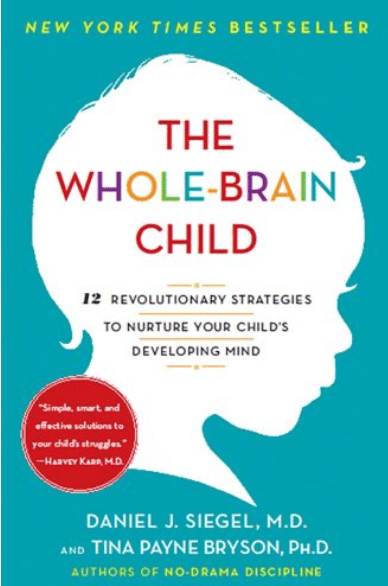
The Whole‑Brain Child explains how children’s brains develop and why connection helps more than correction
Siegel and Bryson’s Whole‑Brain Child framework (2011) is particularly helpful here. Their ‘3 Rs’: Regulate, Relate, and Reason, offer adults a practical way to support emotional regulation through connection, co‑regulation, and reflection.
- Regulate – Help calm the nervous system before trying to teach, explain, or correct. This might look like lowering your voice, offering a calm presence, sitting nearby, taking a walk together, or supporting a child to use a familiar coping strategy such as breathing, movement, or a sensory activity.
- Relate – Connect with the emotion before addressing the behaviour. This could sound like: “I can see you’re angry right now,” or “Something about this has felt too much for you.” Feeling understood helps children feel safe enough to begin regulating. Avoid questions like “Why did you do that?” as they may not yet have the reflective capacity to answer.
- Reason – Once calm has returned, support reflection and problem‑solving. This might involve asking, “What happened?”, “What could help next time?”, or “How can we put this right?” Boundaries, consequences, and learning are most effective at this stage.
The order matters. Adults often move straight to reasoning because we want to fix the problem, but when a child is dysregulated, they simply don’t have access to the part of the brain needed for listening and problem‑solving.
Supporting emotional regulation is not about removing difficult emotions. All emotions provide valuable information. The goal is to help children understand their feelings, develop coping skills, and learn that emotions can be experienced safely.
Responding with curiosity rather than judgement creates opportunities for connection. When children feel understood, they are more able to develop the skills needed to manage emotions, navigate challenges, and build resilience.
Emotional regulation is not learned by being told to “calm down”. It develops through repeated experiences of being supported, understood, and guided. Children also learn by watching the adults around them and noticing how they regulate their own emotions.
There will be days when connection comes easily, and days when everyone needs a little more patience (and perhaps a moment to pause and reset). The aim is not perfection but creating enough safe moments where children experience: “My feelings are manageable, and I don’t have to face them alone.”
This moves us beyond viewing behaviour as something to manage and toward understanding it as communication and connection.
References:
Siegel, D. J. and Bryson, T. P. (2011) The Whole-Brain Child: 12 Revolutionary Strategies to Nurture Your Child’s Developing Mind. New York: Delacorte Press.
Related Posts



This Post Has 0 Comments