As the end of the year approaches, many of us feel the familiar quickening of…
Reclaiming Our Attention: Slowing Down in a World Designed to Distract Us
Reflections on Stolen Focus by Johan Hari and three simple ways we can ALL slow down and improve attention in everyday life.
Have you ever sat down to read something, only to find yourself checking your phone a few minutes later? Picked up your phone to do one thing and ended up scrolling instead? Or walked into a room and forgotten what you came in for? Experiences like these are increasingly common, and many people feel their attention is more scattered than it used to be.
Recently I finished reading Stolen Focus by Johan Hari, and it explores exactly this question: why is it becoming so difficult to concentrate in modern life? A question I’m regularly asking myself!
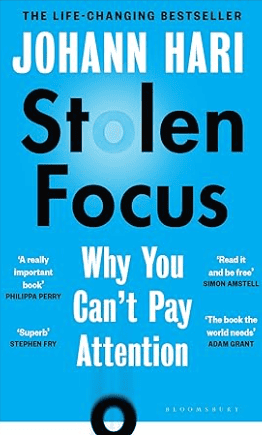
Cover art for Stolen Focus: Why You Can’t Pay Attention by Johann Hari (Bloomsbury Publishing, 2022).
Stolen Focus: Why You Can’t Pay Attention: Amazon.co.uk: Hari, Johann: 9781526620217: Books
In my work as a counsellor, people often describe a sense of mental “busyness.” Some say they struggle to concentrate or feel pulled in multiple directions by constant notifications, information and the general demands on their time. Reading Stolen Focus shone a light on these experiences which are not simply individual struggles, but part of a wider pattern affecting many of us, adults and children alike.
One of the main insights in the book is that our ability to pay attention has been gradually eroded by the environments we live and work in. From digital distractions to time pressure and constant notifications, many of us now operate in systems that reward speed rather than depth. The result is that sustained focus, whether reading a book, following a recipe, listening carefully during a conversation, or concentrating on homework or a work task, can feel harder than it once did.
Another theme Hari highlights is the importance of “deep attention.” This is the state where we become fully absorbed in something such as, a conversation, a creative activity, a walk in nature, or even a quiet moment of reflection. Hari interviews numerous experts in this field who state that these experiences are not simply a ‘nice to have’; they are essential for learning, connection, and our emotional wellbeing.
While many of the challenges to our focus are societal, from constant notifications and overflowing inboxes to heavy workloads and the pressure to multitask, Hari reminds us that attention can be rebuilt (phew!) Small, practical habits in our daily lives can help us slow down and reclaim moments of calm.
Inspired by his research, here are three simple strategies anyone, adult or child, can start using today to improve focus and pay attention more fully:
1. Set digital boundaries
Limit distractions from devices by turning off non-essential notifications, creating phone-free zones i.e. bedrooms, at the dining table, or scheduling short periods without screens. Even a few minutes away from digital distractions can help your brain reset and focus on what matters most.
2. Spend time in nature
Step outside for a walk, observe the world around you, or simply sit quietly in a garden or park. Time in natural surroundings helps reduce cognitive overload and gives the brain space to recharge, improving focus and calm.
3. Practice mindful single tasking
Focus fully on one activity at a time, whether it’s reading a book, listening carefully in a conversation, or engaging in a creative task. By giving your full attention to a single task, you strengthen your ability to concentrate and experience what Hari calls “deep attention.”
When working with clients, I’m often reminded that meaningful change rarely begins with dramatic transformations. More often, it starts with small shifts in awareness and small moments of choice. Books like Stolen Focus remind us that attention is not just about productivity; it’s about how fully we experience our lives and I would highly recommend anyone to read or listen to this book.
In a world that constantly pushes us to move faster, perhaps one of the most powerful things we can practise is simply slowing down and paying attention.
Sometimes, the most radical thing we can do in a fast world, is pause long enough to notice it.
Related Posts


This Post Has 0 Comments